


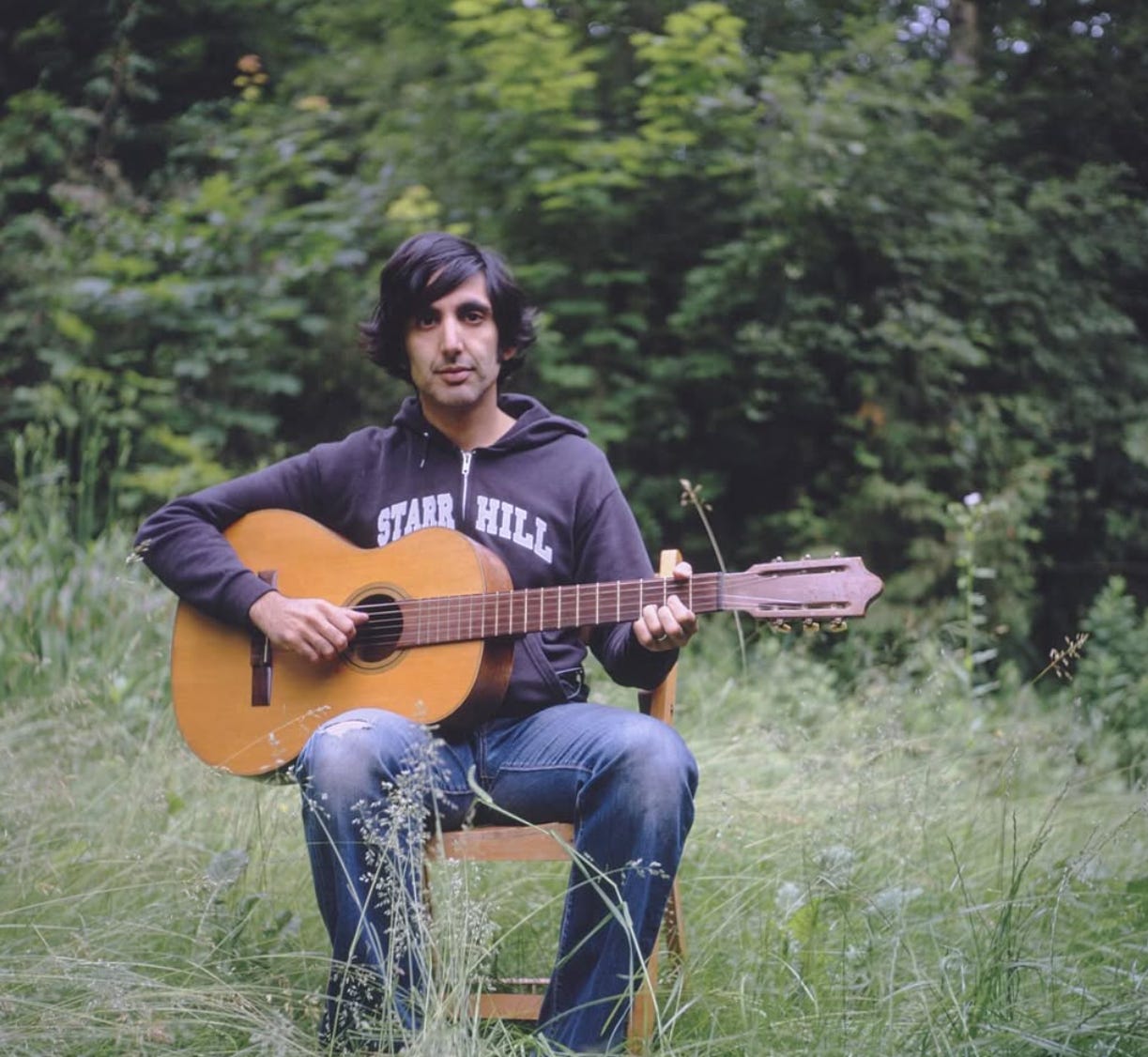
I never considered myself a songwriter. Growing up with an older brother four years ahead of me, I got used to things being passed down. Music, records, attitudes. I was always a few steps behind, absorbing what he’d already figured out. I didn’t say much. I just watched and listened.
I picked up the bass guitar at fifteen. My brother had already started playing guitar by that point, so naturally I followed, just a few steps behind as always. The bass suited me. Bass players are sidemen.. that's just the nature of the instrument. There are exceptions, of course, but historically the bassist is the support system, not the front person. That suited me fine. I was also the sickly one in the family. Asthma kept me out of school for weeks at a time, in and out of hospital. I grew up seeing myself as background. Not the main event.
When I joined my first band, that identity got reinforced. The Sea Beggars (which evolved through personnel shakeups into The Datsons, The Datsons Four—I have a funny anecdote about that name—and then, finally The High Dials) had songwriters with strong personalities. They were a little older than me, believed in themselves, and wanted the spotlight. I just accepted my role. I was the bass player. That was enough.
But then I picked up the sitar.
As I mentioned in previous essays, I came back from India in February 1997 with a student model sitar in a cardboard box and no idea what I was doing. I was teaching myself, slowly chipping away at it with a cassette and a “sitar for dummies” book. Somewhere along the way, something started to happen. The sitar is a melodic instrument. There’s no harmony, just melody after melody. I started storing these melodic ideas in my head, little phrases and motifs I’d pick up from listening and playing along.
Around that time I discovered Ananda Shankar. He was Ravi Shankar’s nephew, and in the seventies he was doing something nobody else was doing: groovy (and at times bombastic) psychedelic sitar music layered with synthesizers. It was wild and strange and completely original. It opened my mind to what the sitar could be outside of classical music. And those melodic ideas in my head started taking shape.
Around 2001, I wrote my first song. It was called 'Things Are Getting Better.' I wrote it completely self-taught, just chipping away on the sitar, listening to cassettes, no formal training whatsoever. The influences were worn firmly on my sleeve: the Nazz's 'Open My Eyes,' a riff I probably nicked from the Ravi Shankar cassette my aunt gave me, and Ananda Shankar's 'Streets of Calcutta.' I had no idea how to approach lyrics, so it remained an instrumental. Even coming up with a title felt like a leap—I ended up nicking it from the Small Faces' 'Things Are Going to Get Better.' I believed in it enough to record it, but not enough to bring it to Trevor, The Datsons' principal songwriter. That felt like too big a leap for someone who still saw himself as the bass player. Robbie, who happens to be one of my oldest and dearest friends, offered to help me record a demo on his 4-track cassette. I have no idea where that demo is now. I remember the thrill of hearing all these ideas I had swimming in my head come to life. Even then, even as someone who'd never seen himself as a songwriter, I believed in that song.
After “Things Are Getting Better,” I hit a wall. I’d maxed out what I could do with the sitar on my own. No teacher, no formal training, just three years of self-teaching and and poor technique. I felt genuinely limited. Like I’d gone as far as I could go without someone showing me the way forward.
Then, sometime around 2001, I was working at a call center. Just another day, just another shift. I noticed a guy across the room. I didn’t know him. But he had a sitar case. I couldn’t believe it. In all the years I’d been playing, I had never met another person who played sitar. Not one. And here was this guy, at a call center in Montreal, with a sitar case sitting next to his desk.
I had to talk to him. His name was Stephen Venkatarangam (AKA The Venk/Black Smoke). He was also Indian, and like me had just started playing sitar. Two Indian guys working at a call center with sitars. You couldn’t make it up. We started talking and he mentioned he’d just started taking lessons from a German guy named Uwe Neumann. Stephen had recently moved to Montreal from Saint John, New Brunswick and would eventually go on to become one of the original members of Elephant Stone.
A German sitar teacher in Montreal? I didn’t even know such a thing existed. Apparently, Uwe had just moved here after completing his master’s in music in India.
That conversation changed everything. I knew immediately that I needed to find this teacher. I needed to go deeper. The wall I’d hit wasn’t the end. It was just the beginning…
Great story so far and I’m looking forward to the continuation! No random coincidences in your musical life for sure! Please also let us know if your brother is still interested in music.
Also a request: please let us know meanings of your bands’ names!
I really enjoyed this. I hadn’t known you were in The High Dials until now. New Devotion had so many great songs. I used to have "Fields In Glass" on repeat. It's a timeless song—it could come out today and still feel completely at home in 2026.