


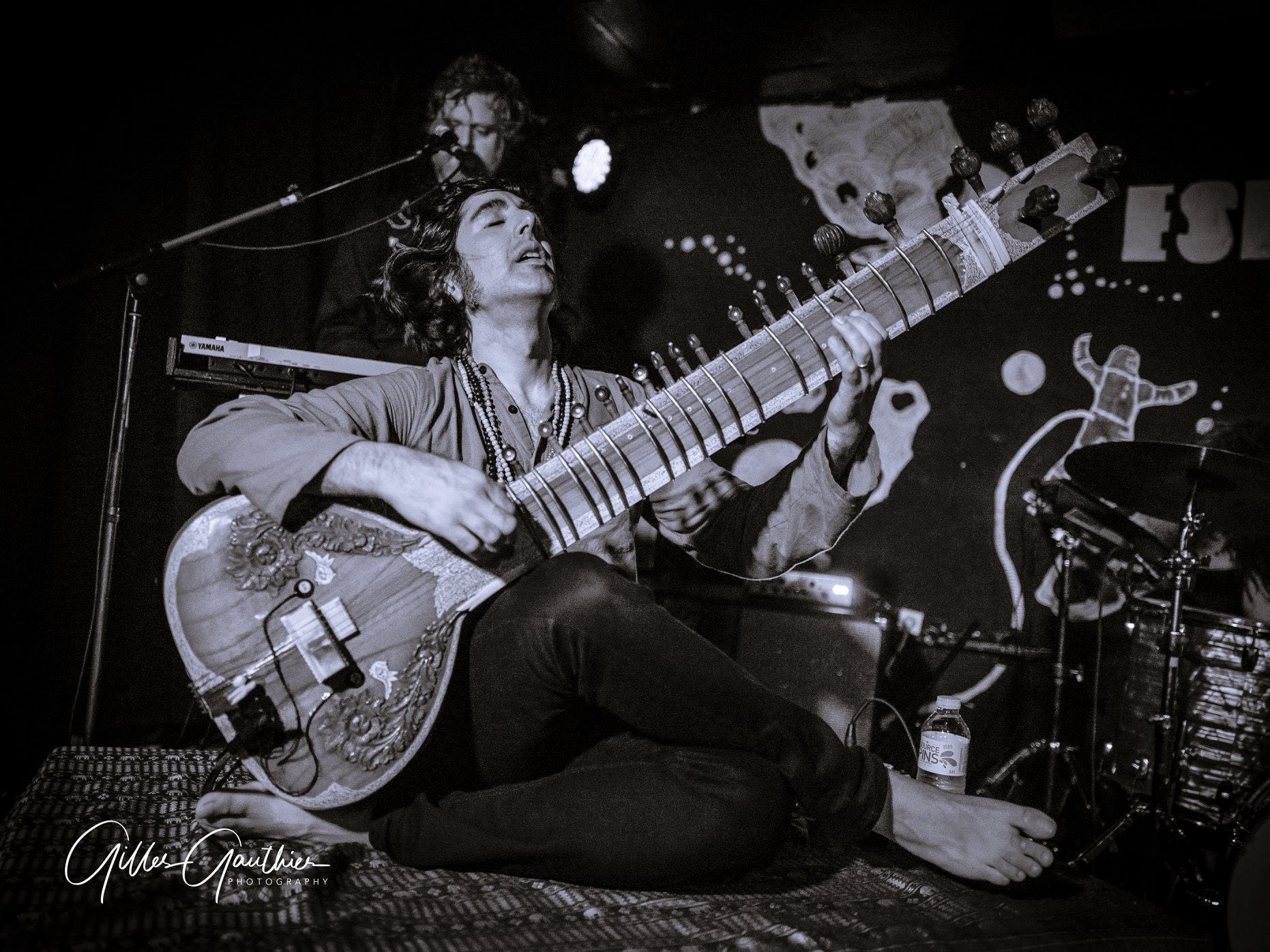
I bought my first sitar on a family trip to India in 1997. I didn't plan it, I just did it. I had no idea then that this instrument would eventually cost me a band, define another one, and become the thing I'd spend years trying to escape.
After almost 10 years playing in The High Dials (through all our many monikers) I began to grow tired of being the sideman and started to crave something more. What that "more" was, I couldn't fully articulate at the time. I was young, and while I had a reputation as the nice guy, I also carried a lot of bravado and ego beneath the surface.
I'm a little embarrassed to admit it, and it's a bit of a cliché, but I saw myself as the George Harrison of the band. We never came close to that level of success, but artistically and philosophically I was searching for something. I had begun taking sitar lessons in 2000 with Uwe Neumann, a brilliant German sitarist who had studied in India for 10 years before settling in Montreal with the Québécoise wife he'd met there. I learned enormously from those weekly lessons. I think that new knowledge made me hunger for something beyond the ultimately unsatisfying life of a struggling indie rock musician. I recall having a bit of an identity crisis around 2006. All the touring had made me feel numb. I didn't believe I was truly following my purpose.
So, long story short, I left the band in September 2006 convinced that I was done with rock'n'roll for good. My plan was to focus solely on the sitar, creating psychedelic instrumentals somewhere in the spirit of Ananda Shankar. No band, no sideman role, no compromise. Just me and the instrument I'd been getting to know. Needless to say, that's not exactly how it went. That idea slowly evolved into songs, the songs needed a band, and the band became Elephant Stone.
The first Elephant Stone album was, in many ways, an experiment in contradiction. The sitar was deeply present, woven into certain songs with real intention…. but sitting right alongside it were straight-up pop songs in the vein of Teenage Fanclub that had nothing to do with India, or psychedelia, or anything I'd left The High Dials to pursue. I was still learning to be a songwriter, still figuring out what Elephant Stone actually was. I was incorporating the sitar as much as I could, but the truth is the two sides of the record didn't fully reconcile with each other… and, honestly, neither had I.
Looking back, I think that tension was real but also generative. I wasn't a novice (I'd spent a decade in a band) but I was starting over in a different way, trying to find the place where the sitar and the song could coexist naturally rather than just share space. That synthesis would take years to arrive. In the meantime, the audience started forming their own opinions about what we were.
People would come up to me afterward, eyes lit up, and the first thing out of their mouths was almost always about the sitar. “The sitar was amazing.” “I’ve never seen a sitar live before.” “You’re the sitar guy.” At first, I loved it. But slowly, almost imperceptibly, it started to chafe.
Because, in my mind, Elephant Stone was so much more than that. I saw myself as a songwriter with something to say, and saying it meant digging into the dark corners of my own life, mining sorrow and sadness in a way I never had before. Writing songs, real songs, meant getting honest with myself in ways that felt uncomfortable and necessary at the same time.
None of that seemed to register. To a certain kind of listener, we were simply the sitar band. I started to resent that. Not the audience… but the reduction.
It didn’t happen all at once. The resentment built gradually, show by show, comment by comment. So I did something that, looking back, seems almost absurd: I started pulling back. Playing less sitar live. Downplaying it in interviews. As if by hiding the thing that made us distinctive, I could force people to hear the rest. I wanted the songs to stand on their own merits, without the “exotic” shimmer of the sitar doing the heavy lifting. What I didn’t realize at the time was that I was essentially punishing the audience for paying attention. Ultimately, punishing myself in the process.
By 2017, I was burned out and restless in a way that felt familiar. Another identity crisis, a decade on. The band felt stalled. My relationship with the music felt stalled. I channeled that energy into two side projects that couldn’t have been more different from each other, or from Elephant Stone. Acid House Ragas was a sitar-driven acid house experiment, a way of exploring the instrument in a completely different context. MIEN was something else entirely: electronic, krautrock-influenced, about as far from Elephant Stone (at the time) as I could get. Both were detours, but necessary ones. (I’ll write more about each in future posts.)
The funny thing about MIEN was that it put me back in a role I hadn't occupied in years; a piece of the puzzle rather than the whole thing. After years of being the sole engine behind Elephant Stone, I was a support musician again. Strangely, that was exactly what I needed. The pressure of being everything to one project had been quietly crushing me. Sharing the load reminded me that collaboration has its own kind of freedom.
What those detours gave me, unexpectedly, was clarity. Stepping away from Elephant Stone forced me to see it from the outside for the first time. I began to understand what the band actually was, what our strengths were, and what made us distinct. And somewhere in that process, stripped of the band context, playing sitar again just for the pleasure of it, I started to remember why I’d picked it up in the first place. Not to be different. Not to stand out. But because something in that sound — the sustain, the resonance, the way a single note can bend toward something that feels ancient and immediate at the same time, had spoken to me since the moment I first brought it home from India.
The reconciliation didn’t happen overnight. Gradually, I stopped thinking of the sitar as a burden or a brand and started hearing it again as a voice. My voice. The irony, of course, is that I left a band in 2006 specifically to follow that voice… and then spent the better part of a decade trying to silence it.
I fell in love with your sound in 2012 or 2013 when I first heard Heavy Moon. I think it might've been on NPR all songs considered or maybe I just heard it on KTRU Houston.
Thank you for sharing your talent. I have all your albums in my Apple Music. You definitely have a heart full of soul.! 😉
I remember the first time I had heard an Elephant Stone song was “Andromeda” back in 2014. I was driving home from work when it popped up on the Chansons station during their mid-afternoon indie bands segment on Sirius satellite radio. Loved that song from the first listen but lost track of your band because I had nothing to write with in the car that day (and there’s so many bands where “Elephant” was part of the name) I had found the song again, roughly 5 years later on Youtube and started doing a deep dive on the music because that’s just what I do when I like a song and want to find out a band’s history and musical output.
The sitar was a welcome surprise on subsequent albums, and I became hooked (*my parents had Ravi Shankar & Beatles albums). I think it brings a very unique quality to your sound without it being a novelty, and it’s used only when the songs call for it.
I was psyched post Covid lockdown Elephant Stone toured again and we drove a few hours south to Connecticut to Club 9 and a couple of years later ES played a theater in Somerville MA (not far from home) It was great to see the audiences really connect with your sound.
Elephant Stone is definitely one of my favorite indie bands from Canada (along with Corridor, No Joy, and Godspeed You Black Emperor)
Looking forward to the new album!