


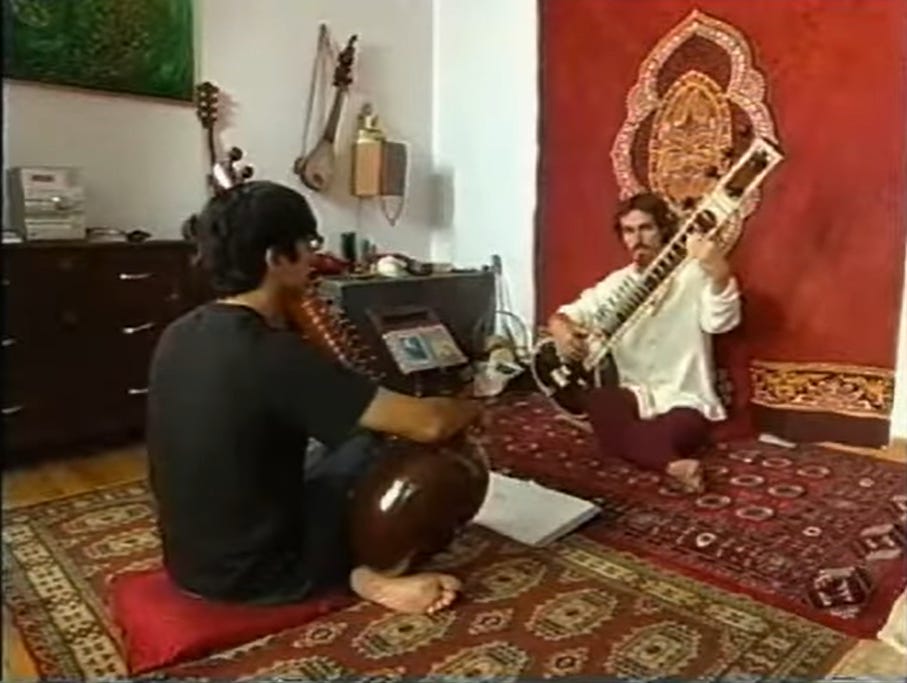
By the time I met Uwe, I’d been teaching myself sitar for three years. Just me, a cassette, a “sitar for dummies” book, and a lot of intuition. I’d developed my own way of playing, my own workarounds, my own sense of what felt right. What I didn’t know yet was how many bad habits I’d quietly built into that foundation.
Uwe was like no one I’d ever met. When Stephen (AKA The Venk/Black Smoke) first told me about him, I remember thinking: a German guy teaching an Indian guy how to play sitar? Let’s see about that. He’d spent ten years in India, in Shantiniketan, studying sitar and Indian classical music, and had earned his master’s degree there. A German guy who’d gone deeper into the tradition than most people born into it ever would. That fact alone should have told me everything I needed to know before I even walked in the door. But I still walked in with my skepticism intact.
His apartment was a top floor walk-up in Mile End. Many stairs. I was living in NDG at the time, the west end of Montreal, so it took a while to make it out his way on the metro. I remember him answering the door with his standard greeting: “Yesss...” A yes that acknowledged you, coloured by his Indo-German accent. He was a bit shorter than me, with a mischievous smile and piercing, searching eyes.
When I get nervous, I tend to talk too much. I was nervous. He just smiled and nodded. I felt foolish. We sat on his Persian rug in his music room, sitars lining the walls, tablas, guitars, even a hammock strung up somewhere in the corner. He asked me to play for him so he could understand what he was working with. I did my pseudo-sitar schtick. This was followed by his long “Yesss...”
I felt very exposed and vulnerable. I never do well in those situations. I had enough false ego at the time that his quiet acknowledgment of my poor skills stung. He told me, gently but plainly, that I’d developed a lot of bad habits. Before we even began, he wanted to inspect my instrument. I mentioned it wasn’t the best. He tuned it up and started playing. I had never heard it sound so beautiful. Turns out the sitar wasn’t the problem.
Then he started with posture. I was sitting cross-legged, but not properly, one leg tucked in sukhasana, the other crossing over the knee, back straight, shoulders relaxed. I’d been slouching over the sitar just to see the frets. Wrong. Back straight, always. The gourd needed to rest in the arch of my bare left foot, not sitting on the floor beside me.
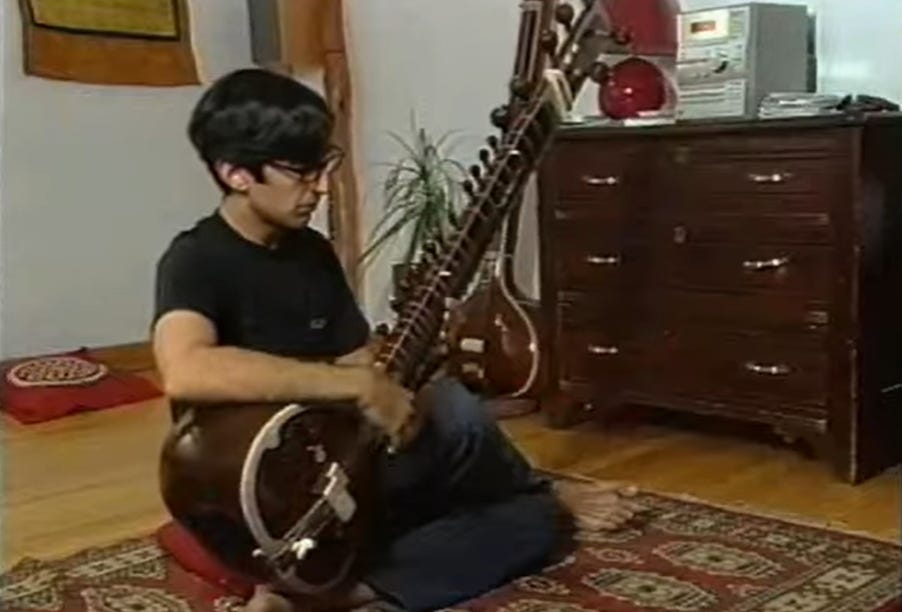
Then he moved to my hands. My right hand thumb was supposed to be anchored on the neck, just before the gourd, not floating free like I’d been doing. From that anchor point, the hand should move like a fan across the strings, alternating up and down strokes, what’s called “da” and “ra” (and “diri” for fast strokes). I’d only ever done downstrokes. I didn’t even know there was another way. The mizrab, the wire plectrum, wasn't even sitting correctly on my finger. It needed to anchor on the first knuckle of my index finger, not wherever I'd been jamming it. My left hand thumb belonged on the center of the back of the neck, and that was wrong too. And you only fret with your index and middle fingers. I'd been using whatever felt right, no method to it at all.
I’d been doing none of it correctly. Three years of self-teaching, and I’d built an entire technique on a foundation that needed to be dismantled and rebuilt from scratch.
And silently, in my head, I couldn’t help but think: you must unlearn all that you have learned.
By the end of that first lesson, I had mentally accepted I was starting over completely. Learning to walk all over again before I could run.
He gave me my first raga: Yaman. A standard major scale with a sharp fourth, a good entry point for a beginner. I’d been tuning to D this whole time, but Uwe tuned to a specific frequency somewhere between C and C sharp. He handed me a CD, a tanpura drone recording of that exact note, and told me to tune to it going forward.
For that first lesson, we didn’t go further than the scale itself, slowly played in da and ra strokes, up and down, over and over until the motion started to feel less awkward. He also told me to get a small pill box, fill it with cotton, soak it in olive oil, and use it to keep my left hand fingers lubricated for playing.
I left that first lesson with a new tuning, a new raga, a new right hand technique, a new left hand technique, and an oil-soaked pill box. Everything I thought I knew about playing the sitar had been quietly, patiently dismantled in about an hour.
Looking back, that first lesson taught me more than technique. Never judge a book by its cover, a German guy turned out to be exactly the teacher I needed. And never let a false ego rule you. It’s a hard lesson when you’re young and still trying to find your way, when every correction feels like a small wound to a fragile sense of self. But humility is where the real learning starts. Uwe knew that. I imagine he’d seen it in students (or himself) before me, probably would see it in students after me too.
I studied with him weekly for over fifteen years after that first afternoon in his Mile End apartment. Fifteen years of “Yesss,” fifteen years of unlearning and relearning, fifteen years of a teacher who never once let me get comfortable with less than my best. That first lesson was just the beginning. I didn’t know it yet, sitting there with my newly rebuilt technique and my little pill box of oiled cotton, but I’d just found the person who would shape the rest of my musical life.
“Humility is where the real learning starts” is useful advice for any new endeavor.