


Every album is a reflection of where I am in my life, and where I am as a musician. Looking back at the records leading up to this one, I can see the arc pretty clearly now.
On our first releases, The Seven Seas (2009) and the self titled (2013), I relied heavily on Jace Lasek for production and mixing. For The Glass Box (2010), I took on more of the production myself, working closely with engineer/mixer Dave Smith. In 2014, on Three Poisons, I tried to step into more of a producer role in a more hands on way. I didn’t really have the technical understanding to fully get there, but worked with engineer Peter Edward to get part way there. Then for Ship of Fools in 2016, I stepped back again and let producer Marcus Paquin guide the ship.
Everything began to change with Hollow, in 2020, the same year we bought our house and I built my home studio, Sacred Sounds. Thematically, it was very much about the songs, side A dealt with climate change and humanity's disregard for it, side B turned inward toward the human condition. But technically, it became something else for me too. It was the record where I really started figuring out how everything actually worked, learning to engineer, learning what made a sound good in the first place.
The real turning point came during COVID, with our French EP, Le voyage de M. Lonely dans la lune. I engineered and mixed it entirely myself.
After that came Back Into the Dream. A friend had given me his old quarter inch tape machine (TEAC 3348), and I ran almost everything through it. It gave the record a certain vibe, but in retrospect I’m a little disappointed with how it turned out sonically. I remember Miles telling me the drums felt quiet, and he was right. I’d hit the tape too hard, and it knocked all the punch out of the transients/attack.
So by the time I started working on this new record, I was determined to actually understand what I was doing. I got deep into studying engineers and mixers I admired, Tchad Blake, Shawn Everett, and I found myself going back to records like Matthew Sweet’s “100% Fun” and Teenage Fanclub’s “Grand Prix.” What struck me listening to them again was how dry they were. After years of burying everything in reverb, I realized a lot of the music I actually loved, even a lot of sixties records, the Beatles included, was much drier than I remembered. I started learning about compression properly, not just as a leveling tool but as something that colors a sound, even shapes it in time, pushing it forward or pulling it back depending on how you use it.
Production-wise, this is the first record where I feel like I really came into my own.
Lyrically, this record feels different too. With every album I’m reaching for something, and it’s always shaped by where I am in my life and what’s happening around me in the world. I listen to a huge range of music, and it all bleeds into what I make. For this one, alongside revisiting Matthew Sweet, I was deep into Robert Wyatt, Harmonium, Lana Del Rey, Blood Orange, Talk Talk, Julian Cope, Frank Ocean, Radiohead… it’s all over the map, and I think that shows in the record.
Looking back at the albums before this one, I can trace a kind of pattern. Hollow was mostly documentary, just observing and recording what was happening around me, though the second side got more personal, more poignant. M. Lonely told more of a story, using narrative as a way of wrapping up what was happening in the world. Back Into the Dream drifted somewhere more abstract, visions and impressions rather than anything grounded. I think I lost some of that poignancy in the process.
With this record, I feel like I found my way back to it, and pushed further than I have before. Songs like “Fascist Killed Your Rock and Roll” and “Everything Evil” came from a place of real confidence, saying exactly what I think. I feel more sure of my own point of view on this record than I have on anything else I’ve made.
But it wasn’t an easy record to make by any means. I lost my friend Christian while I was working on it. I watched people close to me go through genuinely hard times. And while I was finishing the record, my mother passed away.
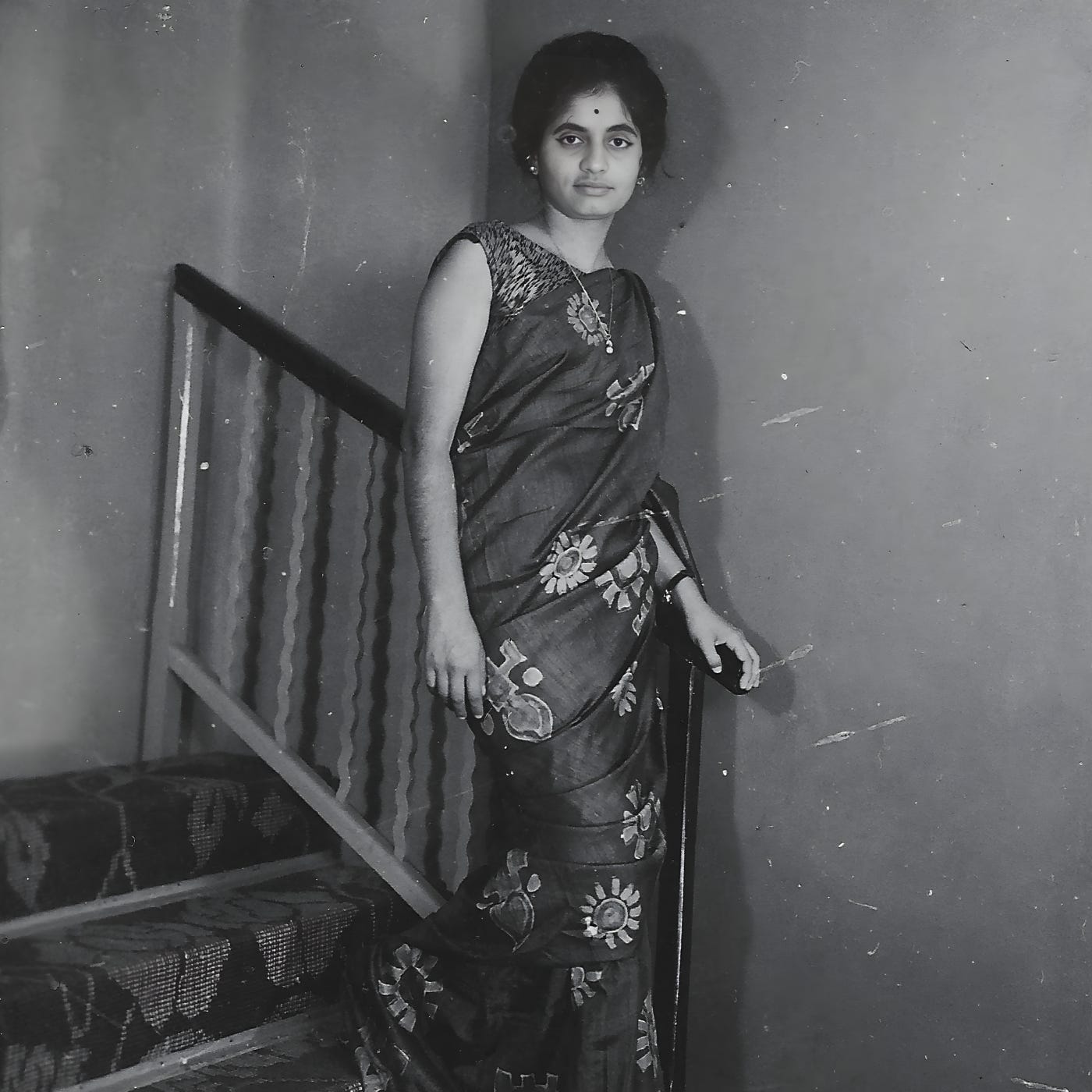
The album is called ASHA. That is my mother’s name. In Sanskrit (and Hindi), Asha means hope.
I decided on the title while she was still here. At the time, it felt like a way of honoring her while keeping some distance, something more abstract, a gesture rather than a direct tribute. I didn’t know then how much that distance would change, or how much I’d need that word, hope, once she was gone.
After she passed, I made the decision to put her on the cover. That wasn’t something I’d originally planned. But once she was gone, it felt necessary; less like a creative choice and more like something I needed to do. Putting her image on the album became its own form of grieving. A way of holding onto her, and of letting her be part of something I made, even though she never got to hear it finished.
I don’t want to say too much more about that part of it… some things are still too close. But I’ll say this: I listen to the record now, all the way through, and it feels like it’s about her. I didn’t intend that consciously while I was writing most of it. It just turned out that way. Maybe it was always going to.
This is the most vulnerable record I’ve made. Sonically, lyrically, and in every other way I know how to measure it. It took me thirty years of making music to get here. I’m proud of it, and it scares me a little too.
ASHA is out August 28th.
Rishi- When my Mom passed away several years ago I adopted her houseplants (there were 3 of them). I still have them, and every time I water them I think of her. Also, I take cuttings and grow new plants and give them to friends, so she still lives on that way. Your music will do the same. I'm sure that our Moms are approving of that.
Ed
Got the elephant stone emailed this morning, the album cover is wonderful your mom, was a gorgeous woman! God rest her soul